Tahoe Unisex Heated Socks 4.0
Ororo
- Runtimelow11.5 hmedium6 hhigh3 h
- Battery7.4 V · 2000 mAh
- Heat levels3
The best balance of stated runtime and price in this comparison.
$124.99per manufacturer, Sep 30, 2026
Check price*
Cold toes end more winter days than anything else. Here are current heated socks side by side – heating zone, battery, runtime and price, every figure sourced.
Updated September 30, 2026 · 6 models · manufacturer specs with sources only
Ororo
The best balance of stated runtime and price in this comparison.
Fieldsheer
The longest runtime the manufacturer states – for long days without recharging.
Savior Heat
Another documented option with a different focus.
Short answer: Heated socks put a thin heating element over your toes and run it off a small battery clipped to the cuff. The three things that matter are whether batteries are included, how long they last on medium, and where the heat actually goes. The longest claims in our comparison are 13 to 14 hours – on the lowest setting. On high, most heated socks give you 2 to 5 hours.
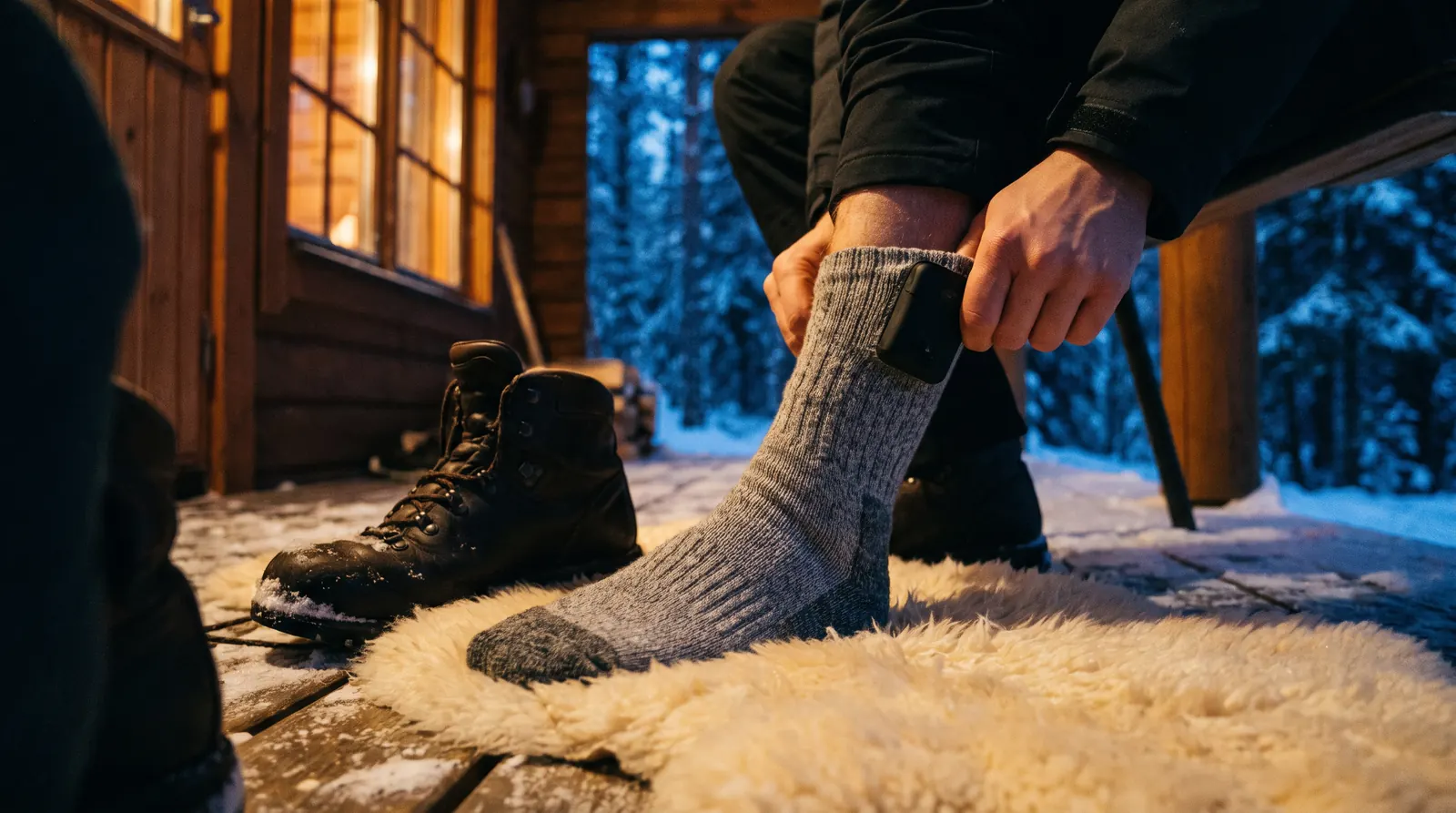
Each sock has a flexible heating panel woven in near the toes. A short wire runs up to a pocket at the top of the cuff, where a rechargeable battery snaps in. Every sock has its own battery, so you're always charging a pair.
The difference from a thick wool sock is simple. Wool only traps the heat your body makes. When you're standing still, your feet don't make much. A heated sock adds its own heat right where you lose it first – in a tree stand, in the bleachers or on a chairlift with the wind in your face.
You control the heat with a button on the battery, a wireless remote or a phone app. Most models have three settings. Fieldsheer offers four.
Yes, as long as you expect the right thing from them. A heated sock doesn't turn a cold boot into a warm one. It keeps your toes from going numb when your body stops sending enough warm blood down to them. That happens fastest when you're not moving: on a lift, in a stand, in the bleachers.
The heat is modest. Glovii caps its top setting at 111 °F (44 °C); Savior Heat and ActionHeat go up to about 150 °F (65 to 66 °C) at the element. That's enough to feel clearly through a merino sock, but not enough to make up for a boot that's soaked or too tight. Heated socks work best with a dry boot that leaves room for your toes to move. If your boot pinches, it squeezes off circulation, and no heating panel fixes that.
They also work best when you switch them on early. Warming toes that are already numb takes much longer than keeping them warm in the first place. Start on medium before your feet get cold, then drop to low once they're comfortable. That also stretches the battery.
This is the single biggest trap in the category. Two socks in our comparison ship without batteries, and both are sold mainly in Europe:
Sidas and Therm-ic share the same S-Pack system, so batteries from one brand work with the other. Every other sock in our comparison comes with a pair of batteries in the box.
Cold feet are almost always cold toes, so most heated socks focus there. The details differ:
G-Heat doesn't say where the Outdoor V2 heats.
Most heated sock batteries run at 7.4 volts. Fieldsheer uses 3.7 volts. That's why mAh alone is misleading. The number to compare is watt-hours: volts times amp-hours. A 7.4 V, 2200 mAh pack holds 16.3 Wh. A 3.7 V, 3600 mAh pack holds 13.3 Wh – less energy, despite the bigger mAh figure.
Our heated clothing battery life guide shows how to turn those numbers into a realistic runtime for your day.
The box always shows the longest runtime, and that's the lowest setting. Look at medium and high instead. Two examples from our data: the Savior Heat ski sock is rated at 13 hours on low, 8 on medium and 5 on high. The ActionHeat Pro Series+ is rated at 11, 6 and 4.5 hours.
Lithium batteries also give up usable capacity in the cold. On a 10 °F (-12 °C) morning, expect less than the box says.
Charge time matters too. Fieldsheer and G-Heat both quote 4 to 5 hours for a full charge. That's fine overnight. It's not enough for a lunch break on the mountain, so a second set of batteries is worth it if you head out twice a day.
Merino blends are standard on ski models. Merino stays warm when damp and resists odor. The sock has to fit snugly, or the heating panel won't sit on your toes. Check the brand's size chart rather than guessing.
None of the brands in our comparison sells a women-specific heated sock. Ororo and Fieldsheer put "unisex" right in the product name, and the others are cut the same way. For smaller feet, the smallest available size is what counts. A sock that's too loose lets the heating panel slide back from the toes, so the heat ends up in the wrong place. Also check the cuff: on a slimmer calf, the weight of the battery can drag a loose cuff down over the course of the day. If you're between sizes, the smaller one usually keeps the panel where it belongs.
The battery pocket adds bulk at the top of the cuff. In a ski boot it sits above the shell. In tight rubber boots it can rub.
Socks go through the wash far more often than a jacket. Always unplug and remove the batteries first, then follow the care label. The basics are the same as for other heated gear – see how to wash a heated vest.
The table lists every model with the manufacturer's own figures. Sort by price, runtime or battery. Blank cells mean the brand doesn't publish that number.
| Model | Runtime (low/med/high) | Battery | Price |
|---|---|---|---|
| Fieldsheer Pro Merino Heated Socks Unisex Merino · Outdoor · App · Heating zone: Toes (top and bottom, dual heat zone) |
13 h 4 h |
3.7 V3600 mAh13.3 Whmax. 135 °F | $159.99
Check price*
|
| Savior Heat Magsnapic Charge Smart Heated Ski Socks (SOS811G3) Ski · App · Heating zone: All round (sole, toes, instep) |
13 h 8 h 5 h |
7.4 V2200 mAh16.3 Whmax. 149 °F | $219.99
Check price*
|
| Ororo Tahoe Unisex Heated Socks 4.0 Everyday · Heating zone: Front of sole + instep (two zones) |
11.5 h 6 h 3 h |
7.4 V2000 mAh14.8 Wh | $124.99
Check price*
|
| ActionHeat Pro Series+ Bluetooth Wool Heated Socks Hunting · Outdoor · App · Heating zone: Sole (entire underside) |
11 h 6 h 4.5 h |
n/amax. 151 °F | $199.99
Check price*
|
| Hotronic Heat Socks Set XLP 1S BT Surround Comfort EVO Ski · Merino · App · Heating zone: Toes (surround, wraps the toes) · other market |
10 h |
n/a | n/a
Check price*
|
| Glovii GQ3 heated socks with remote Everyday · Remote · Heating zone: Forefoot · other market |
6 h 3 h 2 h |
n/amax. 111 °F | n/a
Check price*
|
All values from the manufacturer's page, retrieved September 30, 2026. “n/a” = not stated by the manufacturer. Runtimes are usually quoted at room temperature. Models marked “other market” have no US dollar price listed.
At $219.99, this set includes two 7.4 V, 2200 mAh batteries and a magnetic charging cable. Savior Heat rates it at up to 13 hours on low, 8 on medium and 5 on high. That's the best high-setting figure in our comparison. Heat runs from 104 °F (40 °C) to 149 °F (65 °C) and covers the sole, toes and instep.
Best for: bitter ski days and long, cold sits. Keep in mind: Savior Heat lists its runtimes as ranges; we use the top of each range.
These cost $199.99 with two 2500 mAh Bluetooth batteries and a dual USB charging cable. The heating panel covers the whole underside of the foot. The three settings run at 110, 130 and 150 °F (43, 54 and 66 °C). ActionHeat rates them at up to 11, 6+ and 4.5+ hours.
Best for: hunters and anyone standing on frozen ground. Keep in mind: ActionHeat doesn't publish the battery voltage, and the page quotes both 11 and 11.5 hours for low.
For $159.99 you get two 3.7 V, 3600 mAh batteries and a USB-C cable. There are four settings between 90 and 135 °F (32 to 57 °C), controlled by button or the MW Connect app. Fieldsheer lists 13+ hours on low, 9+ on medium-low, 5+ on medium-high and 4+ on high.
Best for: long days where steady, moderate heat beats a hot blast. Keep in mind: At 13.3 Wh per battery, the pack stores less energy than its mAh number suggests.
The Tahoe is the least expensive sock with batteries included, at $129.99 (Ororo also lists a $124.99 variant). Two 7.4 V, 2200 mAh batteries and a USB-C splitter cable are in the box. Ororo rates it at 11.5, 6 and 3 hours.
Best for: game days, commutes and everyday cold. Keep in mind: Ororo says this model is US-only and can't be returned. Three hours on high is on the short side.
Hotronic's surround element wraps the toes. The set includes a pair of 2200 mAh XLP 1S BT batteries, controlled with the Hotronic Heat app. Hotronic promises "10 hours of constant heating power" without naming a setting.
Best for: skiers who buy through a ski shop. Keep in mind: Hotronic sells through dealers only, so there's no list price on its site.
Lenz is an Austrian brand sold mainly in Europe. The €219.95 set includes a pair of rcB 1200 batteries. Lenz rates it at up to 14, 7.5 and 4.5 hours, with stepless control in the app. Each battery weighs 85 g (3 oz).
Best for: skiers traveling in the Alps. Keep in mind: Lenz doesn't list voltage or capacity for the rcB 1200 on the product page.
A lot of people look for Milwaukee heated socks because they already own M12 tools, jackets or vests. We haven't added Milwaukee socks to our comparison yet, so we can't give you verified runtime or battery figures for them. The same goes for Gerbing, Snow Deer and the store brands at Walmart or Costco. If you're considering one of them, check the same five points as above: batteries in the box, runtime on medium, watt-hours, heating zone and size chart. If a brand won't publish those numbers, that's worth knowing too.
Your feet are locked into a stiff boot, and circulation suffers on the lift. A slim heated sock adds warmth without eating up boot volume. Toe-cap designs like Lenz and Hotronic heat the part of the foot that sits right under the cold boot shell. Aim for at least 7 hours on medium to cover a full day. Of the models in our comparison, Savior Heat (8 hours) and Lenz (up to 7.5 hours) reach that mark, according to the manufacturers.
You sit still for hours with your boots on a cold platform. Runtime matters more than peak temperature, and heat under the sole matters more than heat on top of the toes, because the cold comes up through the stand. ActionHeat heats the whole underside of the foot and is rated at 11 hours on low. A dawn-to-dusk sit is longer than any sock battery lasts, so pack a spare set. Our heated hunting gear guide covers the rest of the setup.
Game days and the commute: Two to four hours in the bleachers or at the bus stop is enough to freeze your toes. A budget model does the job.
Working outside: A full shift is more than almost any sock battery can handle on high. Plan on a second pair of batteries.
Socks heat your toes from above and below. Insoles only heat from underneath, but they work in any boot and never go through the wash. In a snug ski boot, a sock usually takes up less room than an extra insole. In roomy pac boots, insoles are often more comfortable. We weigh it up in detail on our heated insoles page.
If your hands suffer too, see our heated gloves comparison. Not sure what you need for your conditions? The Warmth Finder matches gear to your temperature and time outside.
Yes, for keeping toes warm while you're not moving. They add a small amount of heat right at the toes or sole, which is where your feet lose warmth first. They won't rescue a wet or tight boot, and they work best when switched on before your feet get cold.
On low, for a short time, most people do it without trouble. Sleeping through the night on a high setting is a bad idea, because you won't notice if the heat gets too strong for your skin. If you have reduced feeling in your feet, for example from diabetes, ask your doctor first. Never charge the batteries under a blanket.
Used as intended, yes. They run on low voltage, typically 3.7 or 7.4 volts, so electric shock isn't the concern. The real risks are too much heat for too long and damaged batteries. Use the charger that came with them and don't run high for hours against bare skin.
It depends on the setting and the battery. Manufacturer figures in our comparison range from 6 to 14 hours on low and 2 to 5 hours on high. In real cold, expect less.
Yes, and more often than any other heated gear. Remove the batteries first, then follow the care label for water temperature and cycle. Make sure the sock is completely dry before you plug the battery back in.
Most do, but not all. The Therm-ic Ultra Warm Performance and Sidas Ski Race sets are sold without batteries, and the Therm-ic S-Pack 4000B alone costs €229.95. Always check what's in the box.
If your toes go numb on the lift, yes. You generate heat while skiing but not while you're sitting on a chair or standing in line. Pick a pair rated for 7 or more hours on medium.
Warmth on the toes can ease symptoms, but it doesn't replace a diagnosis or treatment plan from your doctor. Talk to your physician before relying on heated gear. Fine-grained app control helps you avoid running the heat too high.
Usually not, because connectors are proprietary. Sidas and Therm-ic are the exception – they share the S-Pack system. A battery with the wrong voltage can damage the heating element.
* Links marked * are affiliate links. If you buy through them we may earn a commission at no extra cost to you. Placements can't be bought.