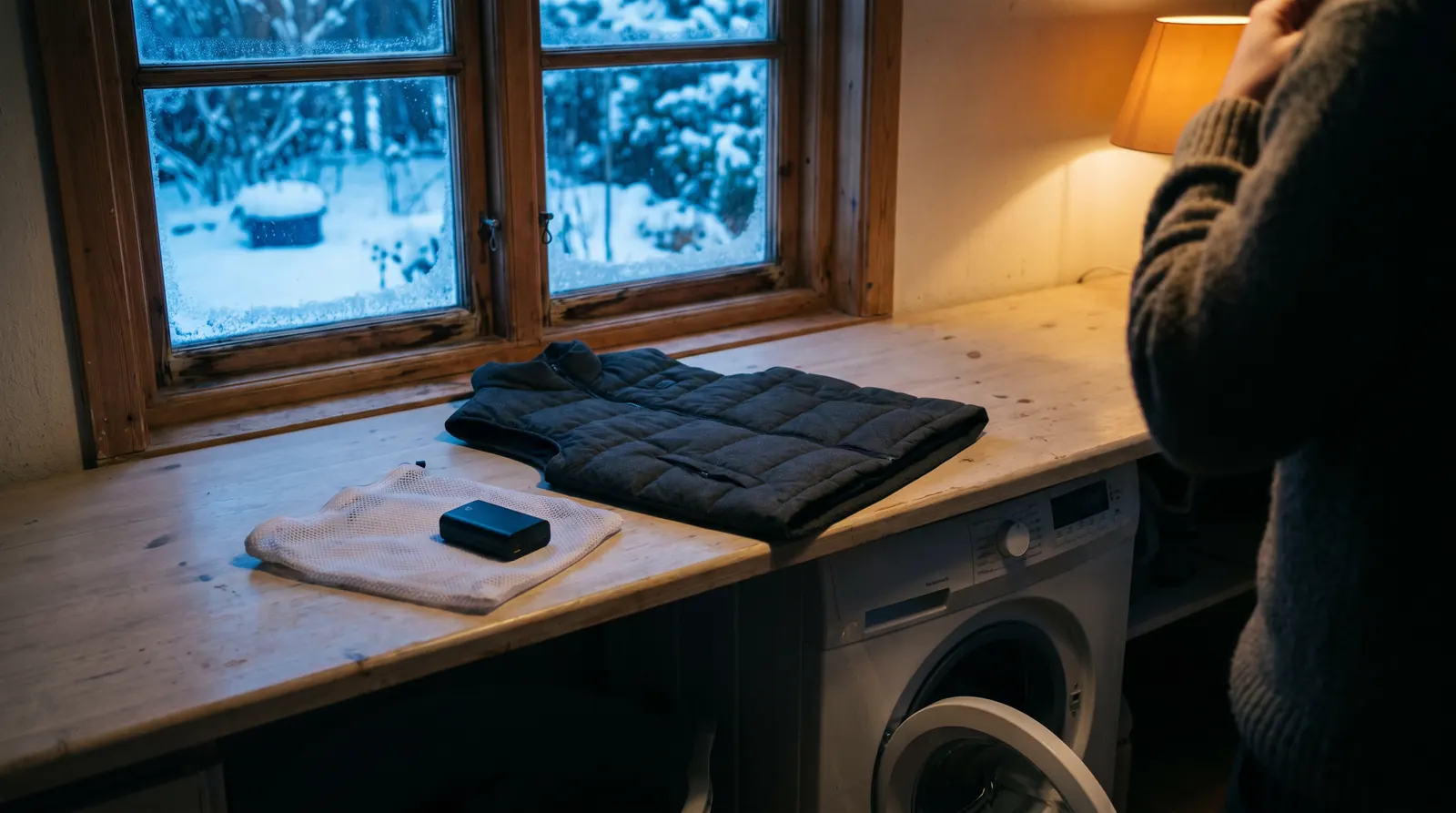
A heated vest looks like any other vest. Inside the lining, though, are heating panels and wiring, plus a connector for the battery in an inside pocket. When you wash a heated vest, the job is protecting exactly those parts. The good news: most manufacturers allow machine washing.
Short answer: To wash a heated vest, take the battery out, tuck the cable into its pocket, and run a gentle or cold cycle. Air dry it, and don't reconnect the battery until everything is completely dry. In our comparison, only Milwaukee allows the dryer. When in doubt, follow the care label on your model.
How to wash a heated vest: what manufacturers say
Instructions vary more than you'd expect. Here's what each brand states on its product pages.
| Brand | Washing instructions (manufacturer) |
|---|---|
| ororo | Machine wash cold on a gentle cycle in a laundry bag. Don't bleach, iron or dry clean. Air dry. |
| Fieldsheer (Mobile Warming) | Remove the battery. Machine wash cold on a gentle cycle only. |
| Milwaukee (US) | M12 heated vests and jackets are "washer and dryer safe." |
| Milwaukee (EU) | Wash at up to 40 °C (104 °F), tumble dry at up to 60 °C (140 °F). Don't iron, bleach or wring. Remove battery and holder first. |
| ActionHeat | 5V fleece vest machine washable on a gentle cycle; Pro Series models described as "machine washable." |
| Venustas | Listed as "machine washable," no further detail on the product page. |
| Glovii | Disconnect battery or power bank and secure the cable. Hand wash or gentle machine cycle per the label. Reconnect only when fully dry. |
| G-Heat | Remove the battery. Mild detergent, no fabric softener. Hand washing recommended; machine at 30 °C (86 °F) with minimal spin is possible. |
For some models, we found no care instructions on the product page: the Gerbing Khione Puffer Heated Vest 2.0, the Makita DCV202 and the DeWalt DCHJ066 jacket. For those, go by the sewn-in care label or the manual.
Step by step: how to wash a heated vest in the machine
These steps sum up the manufacturer instructions above. They work for a heated jacket just as well as for a vest.
1. Remove the battery
This is the step that matters most. Fieldsheer, Milwaukee, Glovii and G-Heat all spell it out. A lithium battery must never get wet. With Milwaukee, the battery holder comes out too.
2. Secure the cable and connector
The power lead usually hangs loose in the battery pocket. Tuck the connector back in and zip or Velcro the pocket shut, so it doesn't bang around the drum. Glovii specifically says to secure the cable.
3. Close all zippers and use a laundry bag
Zip everything up so nothing snags. ororo calls for a laundry bag.
4. Gentle cycle, cold water
ororo and Fieldsheer say cold. G-Heat caps it at 30 °C (86 °F), Milwaukee's EU page at 40 °C (104 °F). Pick a low spin speed. G-Heat recommends a mild detergent without fabric softener.
5. Don't wring, bleach or iron
Milwaukee says not to wring. Milwaukee and ororo both rule out bleach and ironing, and ororo also rules out dry cleaning.
6. Air dry
Hang the vest or lay it flat to dry. ororo says air dry. Only Milwaukee allows the dryer – its EU page caps it at 60 °C (140 °F).
7. Reconnect the battery only when it's bone dry
Glovii states this outright, and it's good practice for any heated garment. Moisture in the connector and electricity don't mix. Give it an extra day if you're unsure.
How to hand wash a heated vest
G-Heat recommends hand washing, and Glovii lists it as an equal option. It's also the safe choice when your brand gives no instructions at all. Here's how:
- Battery out, connector secured. Same as for the machine.
- Fill a sink or tub with cold to lukewarm water and a little mild detergent. No fabric softener.
- Submerge the vest and press it gently. Don't scrub or bunch it up.
- Rinse with clean water until no suds remain.
- Press the water out – don't wring. Rolling the vest in a towel and pressing down works well.
- Air dry flat or on a hanger, not on a radiator or heat vent.
Often you don't need a full wash at all. If only the collar or one spot is dirty, wipe it with a damp cloth and a drop of detergent. That keeps the wiring completely dry.
How do you wash a heated jacket?
You wash a heated jacket much like a vest: battery out, connector secured, gentle cycle, air dry. Jackets just have more heat zones and more wiring – in the sleeves, sometimes in a heated hood. That makes the brand's instructions even more important.
What manufacturers say about their jackets
- Milwaukee: In the US, Milwaukee calls the M12 Heated AXIS Quilted Jacket washer and dryer safe. Its EU instructions come from the M12 heated jacket page: wash at up to 40 °C (104 °F), tumble dry at up to 60 °C (140 °F), remove the battery and holder first.
- Ororo: The Overland jacket and Toasty hoodie are listed as machine washable. Ororo's detailed rules – cold, gentle cycle, laundry bag, air dry – appear on its vest page. The jacket pages don't say whether they apply the same way, so the jacket's care label wins.
- Fieldsheer, ActionHeat, Venustas: The Outrider, the Pro Series+ Softshell and the W2168 are listed as machine washable, with no temperature or drying details on the jacket pages.
- No instructions found: the DeWalt DCHJ066, Makita DCJ205 and Gerbing's 12V Heated Jacket Liner 2.0 have no care instructions on their product pages.
Extra steps for jackets
- Detachable hood: If the hood has its own heating, like on the Ororo Overland, take it off before washing. Check for a loose connector there, too.
- Sleeves with heat zones: Close the cuffs and every pocket, and don't fold the jacket sharply when you load it. That keeps strain off the wiring in the sleeves.
- Drum space: A jacket needs more room than a vest. Wash it alone or with a light load so it can move freely.
- Longer drying time: Thick insulation and cuffs hold moisture. Hang the jacket on a wide hanger and wait until the battery pocket is bone dry inside.
For tool-battery jackets without published instructions, go by the sewn-in label. Models are compared on our heated jacket page.
Puffer and down models
Insulated puffer models came with the least guidance. Gerbing's Khione Puffer Heated Vest 2.0 page has no care instructions. For these, the sewn-in care label is the only reliable source. Read it before the first wash and stick to the temperature and drying method it lists.
Common mistakes when washing heated clothing
- Forgetting the battery. Check every inside pocket before each wash.
- A hot cycle. Going above the manufacturer's limit can damage the lining and heating panels.
- The dryer without approval. In our comparison, only Milwaukee allows it.
- Fabric softener. G-Heat specifically advises against it.
- Plugging in too early. Wait until the vest and the connector are fully dry.
Gloves, socks and insoles
For heated gloves and heated socks, we don't have verified washing instructions from the manufacturers. Go by the care label. The basic rule stays the same: battery off, connector secured, gentle wash, dry completely. For insoles with a built-in battery, read the manual especially carefully.
Care for the battery instead
Never wash the battery itself. Wipe it dry if needed and keep the contacts clean. When you store your vest for the summer, store the battery separately in a dry place. How to judge runtime and capacity is covered in our guide to heated clothing battery life.
Still shopping for a vest that's easy to care for? Our heated vest comparison lists washability for every model. The Warmth Finder shows which body zone to heat first.
Frequently asked questions
Can you put a heated vest in the washing machine?
Yes, most manufacturers allow it – including ororo, Fieldsheer, Glovii, ActionHeat, Venustas and Milwaukee. Remove the battery and secure the cable first. Use a gentle or cold cycle; G-Heat prefers hand washing.
What temperature should I wash a heated vest at?
It depends on the brand. ororo and Fieldsheer say cold, G-Heat up to 30 °C (86 °F), and Milwaukee's EU page up to 40 °C (104 °F). When in doubt, go with cold.
Can a heated vest go in the dryer?
In our comparison, only Milwaukee allows it – its US site calls M12 heated gear washer and dryer safe. ororo specifically says to air dry. For every other brand, air dry.
What if I washed my heated vest with the battery in it?
Then the battery got wet. Don't use it or charge it again, and contact the manufacturer. A damaged lithium battery can be a safety hazard.
When can I plug the battery back in after washing?
Only once the vest – and especially the connector – is completely dry. Glovii states this explicitly. Waiting an extra day is the safe bet.
Can I dry clean a heated vest?
ororo explicitly rules out dry cleaning. Other brands don't address it on their product pages. Skip it and wash gently instead.
Keep reading
* Links marked * are affiliate links. If you buy through them we may earn a commission at no extra cost to you. Placements can't be bought.